BRITISH COMICS
THE UNSOLVED
MYSTERY OF THE 11 LOST FOOTBALLERS
First episode, taken from The Rover issue: 1322 October
28th 1950.
|
|
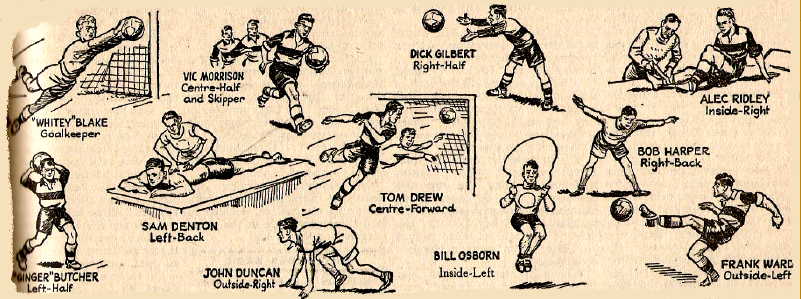
IT STARTS TODAY – The story of the biggest sensation in the history of
football.
THE EMPTY COACH
At
It was all just as usual. There was
nothing whatever to suggest that this was the prelude to one of the most
amazing football mysteries of all time. Major Balfour, the chairman,
accompanied by several other directors, climbed into the coach and took their
seats up front. They were followed by Ted Donald, the manager, Rob Cooper, the
trainer, the selected players and a couple of reserves. Presently the coach
moved away, and it fairly hummed along, reaching the
THE MYSTERY DEEPENS
By this time all
the passengers were looking and behaving normally, except that they were astounded
and bewildered. Detective-Inspector Drew rapped out swift questions, but could
gain no satisfaction from the answers.
The directors, the driver, the
manager, the trainer and the two reserves all gave the same information. They
all recollected the start of the journey, and the first part of it, but after
that they could remember nothing. “Some mighty funny business has been going
on,” said Mr Drew, “but there must be some explanation. You came along a fairly
busy road, and you are not going to tell me that eleven men could alight from a
coach without being seen. Did you stop anywhere for refreshment?” The detective
asked that question because it was obvious to him that the passengers on the
coach had been under some sort of strange influence which had robbed them of
their memory. He suspected that they might have eaten or drunk something to
cause this effect. But he was promptly told that there had been no pause for
refreshment, and, as far as could be remembered, the coach had not stopped at
all. Drew picked up the phone. Knitting his brows in anxious thought, and then
called up a police station in a large town about mid-way between Sefton and
Westwood. He knew the superintendent, and quickly told him what had happened.
“Somewhere or other along the road,” he said, “our coach stopped and the
players alighted. Put out a general call, and ring me here as soon as you have
got any information. I’ll be waiting.” He knew some little time must elapse
before a reply could come through, and he went back to the coach, to ask more
questions. Five minutes later there was a call from the building. Drew was
wanted on the telephone. He raced to the instrument, telling himself he was
going to hear some simple explanation of what at present was an amazing
mystery, but his heart sank when he learned that reports were in from all
stations along the route between Sefton and Westwood, and there was no news of
the missing players. Many police officers had seen the coach passing, but none
had seen it stop. “Keep on with your inquiries,” said Drew, and then went back
to the coach to say there was no news. What was he going to do? He stared at
the passengers, who had now begun to alight. They must know something about it,
he told himself. All he had to do was to awaken their memory. “All come
inside,” he said suddenly. “I’ll ring the doc up.” Fortunately the medical man
who looked after the players was at home, and he came along at once. He
listened with a puzzled frown to the strange story, but said frankly that he
could not think of anything which would have affected the coach passengers in
the manner described. He subjected them to a number of tests, and then shook
his head. “They are all perfectly normal,” he said. “Whatever it was that
caused them to lose their memories has left no trace. I cannot help you, Mr
Drew.” More police reports came through, but still there was no clue to the
strange mystery. All the players’ homes were visited, but none of them was
there. By this time the whole population of Westwood was agog with the news.
Weary, and heavy-hearted, Detective-Inspector Drew hardly slept. He rose very
early and began to put telephone calls through, but still there was no news of
the eleven vanished players. All the newspapers had the story spread across
their front pages. Various ideas were put forward by sports writers, all of
them drawing on their imagination, of course. Some suggested that the eleven
players had been kidnapped, and that was the general opinion. Another writer
asked if there was secret unrest in the club which had caused the eleven men to
disappear voluntarily. All the papers made much of the curious appearance of
the occupants of the coach when it had returned to the ground, also of the fact
that Detective-Inspector Drew had been making investigations, but without any
success so far. As a result of this last statement in the newspapers, Drew
received a telephone call from Scotland Yard. He had to admit that he was as
much in the dark as anybody else, and although due back at the Yard on the
following day, he asked permission to remain in Westwood over the week-end.
This permission was readily given. All through the morning John Drew worked
with infinite patience, tackling the returned passengers one by one,
cross-examining them with all his skill, particularly Sandy Tait, the driver.
But still he failed to find any clue, or to awaken lost memories. When he had
finished his lengthy inquiries, Drew went through his notes, at the same time
studying a map of the route. An idea came to him as a result. Twelve miles from
Westwood a new broadcasting station was being built, surmounted by a lofty
steel tower, but none of the passengers have spoken of having noticed it. Again
Drew began his questioning, this time making a special point of the
broadcasting station, and at last he believed he was making a little progress.
He learned that none of the passengers remembered noticing the new building. As
it was a striking feature of the landscape, Drew felt sure that the loss of
memory had occurred before the coach passed the broadcasting station. On his
map he marked places nearer to Sefton which had been noticed by the travelers,
and this left him with a stretch of about twelve miles. Drew felt a little more
hopeful, though not very much, now that he had reduced the area in which the
disappearance had taken place. If the coach had stopped on the high road, some
people must have noticed. The detective drove over those twelve miles, calling
at houses en route, questioning large numbers of people, but with no results.
Night came without any further news, and on Monday morning the mystery was
still unsolved. Early that morning the detective rang up the Yard, asking to be
allowed to continue his investigations. The superintendent to whom he spoke
most sympathetic, and gave him a free hand. While the detective was hard at
work, a special meeting of directors had been called at the football ground
under the chairmanship of Major Balfour. Apart from the distress caused to the
relatives and friends of the missing men, there was the startling situation
which the club had to face, with all its leading players missing. “I feel sure
they will return soon,” said the chairman, “but we have to consider what will
happen if they do not. Northam Villa are to be here on Saturday. If the men are
not back by then, we will have to turn out our second string, and that means
almost certainly a heavy defeat. But what else can we do? We can’t spend large
sums trying to sign on new players in a hurry, even if they were available. I
feel absolutely at my wits end.” So did the other directors. They foresaw ruin
if the missing men did not return. Another day passed by, and another, but
still the mystery was unexplained, still there was no news of the missing
players. Drew, aided by a large number of police and detectives, continued his
investigations tirelessly, but without result. Then Saturday morning the Board
of Directors met, and, having no alterative, decided to field the reserve side
in the game against Northam Villa.
ONE COMES BACK
Crowds poured into
Westwood that day. Long before the turnstiles were open, there were immense
queues, and in a surprisingly short time the ground was packed. In the
dressing-room, the Westwood side began to change.
Most of the players were silent,
They had talked so much about the mystery that there seemed nothing more they
could say about it. As they began to get out of their ordinary clothes, they
paid little attention to each other, and at first no notice was taken of the
well set up young man who had entered and had stopped by one of the lockers,
preparing to open it, but was now staring round puzzled eyes. “What’s this?” he
asked. “Aren’t we playing the Villa at home this afternoon? Have I made a
bloomer? Is it a reserve game?” At the sound of his voice all the other men
stared at him, none of them speaking at first, all gaping in utter
stupefaction. “Bill—Bill Osborn?” gasped one at length. The newcomer was one of
the missing players! “What’s the matter with you all?” demanded Bill. “Anybody
would think you were looking at a ghost.” All in a moment the pent-up feelings
of the players broke loose. Some shouted, others ran to Bill, shooting
questions at him, and the uproar brought Ted Donald, the manager, hurrying into
the dressing-room. “Now then—” he began, and then his lower jaw dropped as he
gaped at the inside-left. “Bill?” he yelled. “Where on earth have you sprung
from? Are the other boys with you? Where have you been?” “Where have I been?”
repeated the inside-left. “You talk as though I’ve been away somewhere.” “So you
have!” cried the manager. “We haven’t seen you since last Saturday.” “Oh, don’t
talk such nonsense!” exclaimed Bill Osborn, “I’ve just come from—” He stopped
abruptly, a puzzled look coming into his eyes while he stared around at his
wondering audience. “Wait a bit!” he muttered. “I feel sort of hazy. I—I don’t
seem to remember.” Ted Donald silently eyed the returned player. There was a
distinct difference in the boy. His face had more colour than usual and he had
never looked fitter. The puzzled look in Bill’s eyes grew more pronounced. He
shook his head, saying that he thought he had walked into the dressing-room in
the ordinary way, and that he had just come from home. “But now—now I’m not
sure.” He muttered. “What’s it all mean, Ted? What’s all this talk about my
being away for a week?” He was told the strange story. Somebody handed him a
newspaper with the headline “Still no news of the missing Westwood players.” By
that time the news had reached the Board Room, and directors came racing in,
Detective-Inspector Drew with them. But all their questioning led to
naught—Bill Osborn could not remember where he had been during the past week.
Major Balfour told the manager to give Bill a swift overhaul, and Ted Donald
soon announced Bill absolutely fit—fitter than he had ever been. There was a
hasty consultation, for it would soon be time for the players to take to the
field. Drew badly wanted to have Bill all to himself and cross examine him, but
was told to wait until after the match, for it was decided that the lad should
play. Meanwhile, there was terrific excitement out on the ground, as men
carried round blackboards on which were chalked the news of a change in the
team and that No. 10 would be Bill Osborn. When the United went out, there was
a mighty roar of welcome for Bill, everybody agog with excitement, believing
the amazing mystery was going to be explained. Soon the teams lined up, with
the excitement still at fever heat, and the game began. Northam Villa attacking
at once, their superior skill and experience having its effect. The week
Westwood side put up a scrappy show at first, and there was a lot of wild
kicking. Forced on to the defensive, they concentrated on trying to keep their
opponents from scoring. Kicking out, giving away corners, anything to save
their goal, though there was one exception, and that was Bill Osborn. He fell
back to help the defence, and he seemed to be everywhere. Twice in a few
minutes he kicked the ball out as it was on the point of going over the goal
line and soon afterwards he flung himself across and headed out a powerful shot
that had left the goalie helpless. “Never seen him play like it—never!” cried
the manager. “He was always good, but now, by gum, he’s super! Something’s
happened to him while he’s been away. I know that for a dead certainty.” Twenty
minutes passed by without the United players having been in the Villa half, and
during that time the Westwood goal had scores of narrow escapes. Both the
Northam backs were over the halfway line, and their halves were mingling with
their forwards, trying to score. Suddenly, from out of the midst of the crowd
of players on the penalty area came Bill Osborn, the ball at his feet. Two of
the visiting forwards and one of their halves went for him, but he wriggled
past them, lobbing the ball over their heads at the same time. Before they had
time to turn and go for the him again, he reached the dropping ball, took it on
his forehead and nodded it past yet another opponent. A moment later he was
clean away, being chased by the players he had just dodged, while the nearer of
the two Northam backs cut across to tackle him. For a few moments the crowd was
surprised into silence, but quickly a great roar went up, for not only was Bill
drawing away from his pursuers, but he had side-stepped the strong tackle of
the Northam right-back. The other back was pounding towards him, but was too
late to intercept, and there was Bill, streaking towards the Villa goal, chased
by a pack of opponents, and going away from them all the time. Out came the
visiting goalie, in an effort to reduce Bill’s shooting angle, but it made no
difference, for the inside-left swerved past the keeper and ran the ball into
the empty net. Windows in the houses rattled with the mighty yell that greeted
this goal, and the United manager almost hugged himself with delight. The crowd
were still shouting when the Northam centre kicked off again, and then began
another onslaught on the United’s defences. But this time it did not continue.
The fact that they were a goal up put new life into the Westwood lads.
Half-time came with the United still leading by one goal to nil. The Northam
manager had plenty to say to his players during the interval, and they began to
play their usual skilful game in the second-half, and there was always one or
two players shadowing Bill Osborn. As for the United, they were a goal up, and
they concentrated on keeping their lead. About ten minutes from time, in
desperation, the visitors put all they knew into one mighty onslaught and this
time they were rewarded when the centre scored a clever goal. With the score
one-all and less than ten minutes to play, the Northam men went all out for
another goal. Again and again Bill Osborn came to the rescue when a score
seemed almost certain. Attack after attack he broke up before the whistle
sounded for time. The unexpected had happened and the United had managed to
secure a point. At last John Drew was able to cross-examine Bill Osborn, but
the questioning got him nowhere. Bill just could not remember anything after
the early part of the journey on the previous Saturday until he walked into the
dressing-room that afternoon. Meanwhile, a large number of excited spectators
remained in the enclosure, and none of them took any particular notice of a
tall, elderly man who had joined the crowd for a few minutes then quietly left
the ground. His face, partly shadowed by a big, black deathly pale. His nose
was also long and thin, his eyes half-closed. No-one had spoken to him, and he
had not spoken to anybody. But if anyone had paid attention to him they would
have seen that he was vastly pleased with the display given by Bill Osborn. He
had followed the play closely, using a pair of powerful field glasses and
always he had concentrated on watching Bill Osborn. At length the enclosure was
emptied, and players and officials began to leave, still with the mystery
unexplained. But the detective had not finished. He took Bill Osborn with him
in a car along the road to Sefton, questioning him continually. Eventually they
came to the twelve miles which Drew had marked off on his map, and then the
questioning was like rapid fire. “Yes, I remember noticing those houses!”
exclaimed Bill suddenly, pointing to some farm buildings and cottages. “I
remember saying to your son that it was a lonely place for anybody to live.” A
murmur of satisfaction escaped Drew’s lips. At last he had found a clue.
Somewhere between the farm and the partly built broadcasting station must be
the place where the coach had stopped on the previous Saturday. He turned his
car, and drove very slowly, still questioning Bill, who now remembered one or
two parts of the road which he had noticed during the journey from Sefton. But
that was the end, and he shook his head. “No, I don’t remember any more,” he said.
Drew smiled ruefully. He had narrowed down the blank space on the road to less
than six miles. Those six miles must be covered thoroughly. Broadcast messages
must be sent out asking for people who had been there last Saturday to get in
touch with the police. All houses by this stretch of the road, or anywhere
near, must be visited and their occupants questioned. The work began. It was
carried out in the most painstaking manner and eventually the investigators
were rewarded. There was a sick man in one of the houses. He had been taken
unwell on the Saturday when the players had vanished, and he had been only
partly conscious since then, but he was now recovering, though the doctor was
very puzzled by the illness. “Yes, I saw the coach stop, sir,” he said to Drew.
“It was a big blue coach, just like you describe. I saw some fellows getting
out, and they were carrying bags. But I didn’t take much notice of them.”
Eagerly Drew went on questioning him, and learnt that he had a hazy
recollection of seeing a big motor van nearby, and he thought the men were
walking towards it, but was not sure. “I was beginning to feel queer then,” he
went on, “and I made for home. I had to cross the road to get to a path across
the fields, and I remember a big car passing slowly. I noticed it specially
because I caught sight of a weird-looking gent in it. He had a black soft hat
on, and his face looked pale, almost like a dead man’s. But I remember that he
was smiling, though it was a strange sort of smile.” Drew’s lips tightened. Was
this pale-faced stranger behind the grim mystery? He had to try to find out who
the van belonged to—where it went. But there was one thing of which he felt
fairly certain, though he kept that to himself. He believed the witness must
have been affected in the same way as the players, and that was the cause of
his puzzling illness.
Each week the number of lost footballers was reduced. So the last
episode title is:
THE UNSOLVED MYSTERY OF THE LOST
FOOTBALLER – Last episode, taken from The Rover issue: 1329
December 16th 1950
|
NEW READERS START HERE. After
the match at Sefton, the whole of the WESTWOOD UNITED team is
kidnapped. DETECTIVE-INSPECTOR
DREW is in charge of the case. Drew’s son TOM, is
one of the kidnapped players. Drew
is convinced that an insane scientist, with a deathly-pale face, is
responsible for the kidnapping. One
by one the players return and are perfectly fit, and their game has improved
tremendously. Unfortunately
they have lost their memories for the time during which they were away and
cannot help Drew. All
the players have now returned except centre-forward Tom Drew. Late
one night Drew is called to the phone. He hears an excited voice say,
“Millchester police this end, sir! We’ve
found the man you’re after. We’ve found the house. |
|
|
|
While the police scour
the country for him, the unknown scientist continues his experiment on Tom
Drew. |

THE HOUSE OF MYSTERY
We’ve found the
house!” Those words coming over the telephone wire from the police in
Millchester to Detective-Inspector Drew, came like water in the desert comes to
a man dying of thirst. They brought new life to the detective.
All at once, the anxiety seemed to
leave his face, the weariness and despair brought on by the events of the past
two months vanished as if by magic. “My son?” he demanded. “Is he safe?” “We
haven’t taken any action yet,” replied the Millchester superintendent. “We’ve
got the house surrounded. No one can get in or out without our knowledge. I am
not proposing to take any further steps until you get here.” “Right!” snapped
Drew. “I shall be there as soon as possible.” I’ll meet you at the by-pass,”
responded the superintendent. “It will give us a chance to talk things over.”
Drew raced to the garage, got into his car and headed for Millchester. His foot
was hard down on the accelerator all the way, and his powerful car fairly ate
up the miles. At the by-pass he caught sight of a police post, and saw a patrol
signalling him to stop. He slowed down as he recognised the Millchester
superintendent among the officers. Drew hardly stopped. He jerked the near-side
door open, shouted to the superintendent to jump in, then sent his car flying
again. “Any more news?” he demanded. “No, Mr Drew, except that it is thanks to
you that we found the house. You remember you spotted a car which you suspected
but had no chance to follow, and we tried to pick it up, but failed because we
believed it had some means of changing its number plates?” “Yes,” replied the
detective. “Well, the description you gave was so exact that the car was
spotted to-day, through the lettering and the number was different. It was
followed by a driver who knew his job, and it led us to the house where we
believe your son is imprisoned. “You mean you don’t know for certain?” cried
Drew. “We’re fairly sure,” answered the superintendent. “Hidden watchers kept
the house under observation, and one of them caught a glimpse of that scientist
fellow with the deathly-pale face.” “Why didn’t you raid at once?” snapped
Drew. “We are under your orders, sir,” replied the superintendent. “Yes, yes!”
muttered the detective. “I ought to have ordered a raid when you telephoned.
Have you thought of a secret exit?” The Millchester superintendent said that he
had, and that he had cordons at various distances away from the house, with
orders to stop any vehicles and search them. I’m pretty certain,” continued the
superintendent, “that our man is still inside, your son, too.” Drew continued
to drive swiftly as his companion directed. “Nearly there now!” said the
superintendent as the car whirled round a corner into a wide road lined with a
few large houses, each of them standing in extensive grounds. At a signal from
the V. Drew stopped his car at the side of a tall hedge. He jumped out, eager
to get to work, and his companion pointed to the roof of a large house which
could be seen across the top of the tall hedge. “That’s the house!” he said.
“You can’t see any of my chaps. They’re all hidden nearby, though, and are just
waiting for the word to raid the place.” Drew nodded his head. He was tempted
to give the order there and then, but decided to survey the position first.
Stealthily he moved nearer the old house, keeping under cover, until at length
he was able to see the massive front door. “That will be locked and bolted,” he
whispered. “Have you made preparations for breaking in?” The superintendent
pointed to a grove of thick bushes, saying that it hid a team of men with a
battering-ram.
DREAD DECISION
Moving stealthily,
so that they could not be seen from the windows of the old house, Drew and the superintendent
made their way to the grove of bushes. Here, twenty powerful policemen knelt by
a heavy steel girder.
Drew talked to them in low tones.
He warned them that the attack had to be a complete surprise. “The man inside
is not a magician, though some of his achievements almost suggest that he is,”
continued the detective. “To bring his mysterious influence to bear on us he
must make use of apparatus, and what that apparatus is we do not know. What we
must do is capture him before he has a chance to reach it. The moment we are
inside, fan out, and catch that madman at all costs. Got That?” The policemen
nodded their heads and Drew turned to the superintendent. “Everybody else is
prepared, I take it?” he asked. “Yes, Mr Drew. If we break in, there are a
number of men waiting to rush in after us.” “Right!” exclaimed the detective.
“Get going!” The superintendent signed to the policemen. They rose to their
feet holding the heavy steel girder easily between them. “Now!” shouted
Inspector Drew. The big policemen moved like a machine, running in step and at
great speed. A few steps brought them to the front door where they swung the
heavy steel girder with terrific force. CRASH! Massive though the door was, it
could not stand up against that mighty onslaught. Bolts and hinges were torn
away as if they were made of paper. At the farther end of the hall were double
doors, from the other side of which came crackling sounds, something like the
atmospherics that are heard on the wireless when a thunderstorm is in progress.
“In there!” shouted Drew, who had followed close on the heels of the batter-ram
party. The twenty policemen collected themselves for another charge, but the
detective raced past them. The two doors at the other end of the hall were
vibrating slightly, suggesting to him that they were not locked. He leapt at
them, they swung open, and he charged through, followed by police. Gun in hand,
Drew lurched on, but came to a sudden halt as he stared at the extraordinary
scene before his eyes. Meanwhile, obeying the order they had received, police
poured in after the detective, and spread out all round the room. “Tom!”
whispered Drew. There was his son, lying full length on a wooden construction
that resembled an operating table such as surgeons use. By him stood the man
with the corpse-like face, a white overall reaching to the knees of his
trousers. Tom seemed to be quite unconscious. Some little way above him,
running in horizontal lines, were a number of slender glass tubes, which
contained different coloured liquids. Wires descended from these tubes, joining
into one just above Tom, and this one wire was attached to a pad which rested
over the lad’s mouth. Near at hand were small tables on which stood scientific
apparatus such as Drew had never seen before. There was delicate machinery and
intricate masses of tubes similar to those above Tom. From most of these tubes
came the crackling noise which Drew had heard from outside. Mingled with these
sounds was the steady humming of electric dynamos, with sparks radiating from
their copper coils. It was like a scene from a fantastic dream. The strangeness
of it filled the newcomers with awe, and stopped them in their tracks. Only one
person in that great laboratory appeared cool and calm and that was the man
with the corpse-like face. His long, thin face was quite expressionless. He
seemed utterly unperturbed. Drew was the first to recover himself. He levelled
his gun at the still figure of the scientist. “Stay where you are! Don’ move!”
he barked. No longer was the strange face expressionless. The scientist thinly
as he gazed at the gun—a smile of scorn, as much to suggest that a fire-arm was
a child’s toy compared to the power he had at his command. Despite the strong
force of police, Drew was afraid. Something might happen at any moment—some
mysterious force or influence might be projected from these crackling tubes.
“If you move without my permission I shall shoot,” he said hoarsely, and then
pointed to Tom. “Is—is he alive?” he asked. “Yes,” answered the man with the
deathly-pale face, his voice so thin and reedy that it hardly sounded like a
human voice. “But,” he went on calmly, “he could be dead in a moment, if I
wished.” That was what Drew feared. At last he had caught up with the man of
mystery, but the danger was by no means at an end. On the other side of the man
with the corpse-like face, though some distance from him, stood the
superintendent. He was signalling to Drew, trying to attract his attention. It
was plain that he wanted the order to grab the scientist. But Drew feared to
give it. He was afraid of the unknown powers of the man who stood by Tom, and
he shook his head. “You are wise, Mr Drew,” said the scientist, who evidently
understood what was happening, though his back was turned to the
superintendent. Drew racked his brains for some inspiration. What should his
next move be? He had found his son, he had found the man whom he regarded as an
enemy, but the latter still seemed to be master of the situation. “I am the only
man on earth who is able to restore your son,” said the scientist. “Do you wish
me to do so, Mr Drew?” “Yes,” answered the detective. “Then, have I your
permission to move.” The question was asked in a tone which suggested that the
scientists was amused by having to ask for permission. “It might be better not
to wait any longer,” he went on. “Your son had a fuller treatment than usual.”
Drew’s muscles tautened. He felt an almost uncontrollable desire to hurl at
this madman. But he feared the unknown, he feared the consequences of such an
act. But if the man with the corpse-like face moved, what was to prevent him
from using his amazing powers to bring about disaster? Never in his life had
Drew found it so difficult to make a decision. Yet he must act soon. The only
alternative was the risk of a sudden attack on the scientist—an attack which
might easily bring death to Tom. At last Drew decided. “Restore my son,” he
said, his voice harsh with emotion. “But,” he added in grimmer tones,” one
false move from you—and I shoot to kill.”
THE STORY OF DR HERMANN
The man with the
corpse-like face smiled. “It will take a little while,” he said, “but have no
fear.” He stepped closer to Tom, and slid aside a panel in the wooden table on
which the lad lay. Instantly rows of buttons and small levers came into view.
The scientist pressed one of the
buttons, and Drew tensed himself for action, but nothing startling happened.
Some of the tubes above Tom changed colour, and little streaks of light, like
moving fire, coursed through them. Hardly breathing, Drew watched the scientist
depress a lever, and some intricate apparatus on the table nearby gave out a
whirring noise, and at the same time, one of the dynamos became still. Now the
man with the corpse-like face seemed as if he were quite unaware of the
presence of Drew and the police. He had eyes only for Tom, who continued to lie
so still that he might have been dead. The long thin fingers of the scientist
touched buttons and levers, and with each movement there came a change. The
coloured streams in the array of slender glass tubing kept altering—blue became
crimson, then orange, then silver. Brilliant flashes, like small slabs of
lightning, shot from the apparatus, sparks flew up from the dynamos, and all
the time there was that continuous hum and crackling. Soon there came a loud
hissing noise, and then all the colour left the array of glass tubing. Drew
caught his breath. Suddenly a choking gasp left his lips. His son’s figure was
no longer rigid and still. Colour had come back into the cheeks which had been
so waxen, and at the same time the lad’s eyes opened. He lifted his head and
the pad fell away from his mouth. He sat up and his legs slid off the wooden
structure. He stood on his feet and saw his father. “Why, Hullo, Dad!” he
exclaimed, reaching out his hand to grip his father’s. “Why, where—where—” he
went on, only to stop speaking, overcome with amazement as his gaze fell on the
amazing scene around him. Drew and his men forgot everything else for the
moment. Their attention was concentrated on Tom. None of them looked at the man
with the corpse-like face. Had they done so they would have seen his features
contract into a strange grin. Suddenly he moved with the speed and silence of a
leaping tiger. He flung himself flat on to the wooden structure. With one hand,
he placed the pad over his mouth and with the other he swiftly touched some of
the levers and buttons. Instantly, what looked like coloured fire began to race
through the glass tubes again, and his eyes closed, his body became rigid. Drew
had turned his head just in time to catch a glimpse of the look on the
scientist’s face as he pressed the pad over his mouth. Later on, when he was
able to think clearly again, Drew gave it as his opinion that the scientist had
suddenly made up his mind that events were too strong for him at last, that he
would never be allowed to continue his strange experiments. Thus he had decided
to finish it all by turning the unknown influence on himself. “What’s he doing
now, sir?” gasped the superintendent. “I—I don’t know,” muttered Drew, taking a
hasty step forward and reaching for the pad with the idea of removing it from
the man’s mouth. “Don’t touch anything, Dad!” cried Tom. “Death—yes, that was
what he said. Never touch, it might mean death. He kept telling me that.” Some
of the scientists who had been called in to help try to solve the mystery were
still in Millchester, and Drew sent police to fetch them. Soon the scientists
arrived. They grouped themselves round the rigid figure on the wooden
structure, but they could not make out what was going on. They were familiar
with some of the apparatus, but most of it was unknown to them. A long
discussion took place, and at length a decision was arrived at, and a lever
controlling some of the dynamos was pulled over. The whole apparatus then
ceased to function. The humming sounds ended, the contents of the glass tubes
ceased to move and all the colour vanished. Then the man on the wooden
structure moved. The pad slipped off his mouth, and he sat up. No longer was
his face like that of a corpse—the strange paleness had gone. He looked rather
younger, and he was smiling. “Why, surely it is Peterson!” he exclaimed, gazing
at one of the scientists. He glanced round in a puzzled manner. “What’s this
place?” he asked. “How did I get here?” His face seemed completely altered. It
was like the face of a kindly elderly man—a face that Professor Peterson knew.
“Merciful powers!” exclaimed that scientist. “It’s Hermann! I—I—we—we thought
you dead.” Sure enough, the mystery man was Dr Hermann, who had vanished many
years ago, when he had been so eccentric it was believed he was losing his
reason. But now he was quite sane, though utterly mystified. He had no
recollection of what had happened, and when he heard the name of the football
club he shook his head. “Westwood United?” he repeated. “What has a football
team to do with me?” Before the other scientists attempted to explain, they
drew his attention to the mysterious apparatus, but he looked at it as if he
had never seen it before. “Most interesting!” he said. “I should like to
examine it carefully, but first of all, please tell me how I come to be here.”
All attempts to reawaken his memory failed. He now had no more knowledge of his
amazing apparatus than his companions had. In the case of the disappearing
footballers, their minds had been blank for the space of weeks, but in Dr
Hermann’s case it was a space of years. Drew waited no longer. He left the
puzzled scientists discussing the matter and went out to join his son, who had
been talking to the police and had heard the whole strange story. “Your mother
is waiting, Tom,” said Drew, and then drove his son to their home in Westwood.
So ended the most amazing mystery
that the football world had ever known. Like the other returned players Tom was
far fitter in every way than he had ever been, and on the following Saturday,
Westwood United turned out its full team. Blake; Harper,
Dr Hermann was dead!
THE END
THE UNSOLVED
MYSTERY OF THE 11 LOST FOOTBALLERS – 8
Episodes appeared in The Rover issues 1322 – 1329 (1950)
FOLLOW UP
SERIES:
THE SON OF THE
LOST CENTRE-FORWARD – 11 Episodes
appeared in The Rover issues 1330 – 1340 (1950 - 1951)
© D. C. Thomson & Co Ltd
Vic Whittle 2007
